-
The Purpose and Goal
This blog will be used as a vehicle to discuss the issue of domestic violence through the lens of prison abolition. Resources that are shared on this blog will seek to finds ways to effectively address the issue of domestic violence while simultaneously averting people away from the criminal justice system. Links to websites or videos with more information can be found within each post. My hope is that you will be left with a different perspective and intrigued to find out more as to how prison abolition works and how it can become a reality.
-
Vice – Confronting Domestic Violence Abusers
This video, produced by VICE news, looks into addressing the issue of domestic violence by looking into a rehabilitation program aimed at counselling domestic violence perpetrators. The work of Jackie Freeman, from the program Resolve to Stop Violence, is shown with her talking with incarcerated men, trying to get them to understand what an abused person feels from her own personal experiences. Inmates are then shown discussing collectively what they personally learned from hearing Freeman’s story, while also reflecting on their own problems.
The video also discusses the pitfalls of incarcerating domestic violence perpetrators, such as increasing the likelihood of committing domestic violence again. Leigh Goodmark, a lawyer and university professor, points out that by incarcerating men, they are exposed to a violent and traumatic environment and makes it harder for that man to then get a job when released, both factors that can contribute to an increased likelihood of committing domestic violence again. The video makes a good case for rehabilitation programs as an effective alternative to incarceration, as statistics indicate that 80% of those who attended a Resolve to Stop Violence program were less likely to re-offend within the first year of being released from prison.
The use of rehabilitation programs over incarceration is one of the many tools that prison abolition seek to use to treat and remedy crime rather than punish it. By allowing an individual to heal traumas in their lives that led to them committing a crime, it benefits society by effectively addressing the route causes for domestic violence. With hope, perhaps rehabilitation programs will be used in the future as the first step for combating domestic violence within society.
I encourage you to watch the full video by clicking the link above and hopefully it will give you a new perspective on how we can combat domestic violence more effectively.
-
PBS NewsHour
This segment by PBS examines the stories of formally incarcerated women and aims to address the problematic effect that incarceration has on women who have experienced trauma in their lives. PBS brings up that statistics show between 70-80% of incarcerated women have experienced domestic violence in their life and little is done to address the needs of these women while in custody.
The program A New Way of Life is examined in the video, which provides women housing, legal help and therapy. The women shown in the segment are seen bettering their lives through the program, which puts them on a path to success through healing. Despite the positives of this program, unfortunately not enough exist in place for previously incarcerated women, who are vulnerable to end back up in prison again. Hopefully this program will shed a new light on the issues incarcerated women face and allow for more discussions within society on the importance for more programs for women.
By incarcerating women who have faced domestic abuse and punishing those with drug issues, it often exacerbates these problems especially when no help or resources is made available for these women. Instead of incarcerating victims, they should be provided with the opportunity to rehabilitate through programing that diverts them from the criminal justice system. I encourage you to view this video by clicking on the link above and hopefully it will leave you thinking in a different perspective.
-
Transformharm.org
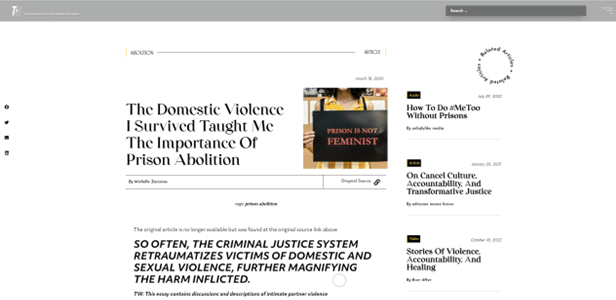
In this article, Michelle Zacarias discusses her personal experience of surviving an abusive relationship when she was 22, while averting the use of law enforcement on her abuser. She also shares her views on prison abolition and how it helped shape the decisions she made to get out of her abusive relationship.
Michelle share the struggles that her ex-boyfriend David went through a disenfranchised black man from Chicago and how the system ultimately failed him. She also touches on how the abuse started and how her social environment influenced her to stay quiet on her abuse for a while. She talks about how she decided against calling law enforcement, explaining that she faced significant challenges as a queer, disabled, Brown woman, as she states that police were “less likely to respond to reported violence against victims with disabilities”. She further discusses the struggles that disenfranchised, racialized and disabled face when dealing with law enforcement and abuse.
I encourage you to have a read over her article by clicking on the link above, as I believe it provides valuable insight into the struggles of an abused woman who also face challenges for being who she is, as well as her abuser.
-
University of California Press

This article, written by Leigh Goodmark, explores her view on domestic violence and prison abolition from her own experiences as a lawyer. Goodmark, who was also shown in the VICE video linked at the top of the page, discusses her journey to becoming a prison abolitionist and what led her to writing a book on the topic of domestic violence within the context of prison abolition.
Goodmark discusses how while she was at first very much in favour of locking up those who committed acts of domestic violence, she quickly learned through her work the detriments this had on victims. Goodmark brings up the fact that by incarcerating individuals, it only made individuals more likely to re-offend by committing more acts of domestic violence. Perhaps this is due to the fact that prison has been shown to do little to address the needs of individuals that commit these types of offences in the first place, as well as creating more trauma by being in a violent environment.
Goodmark also touches on what she would have changed in her original book she wrote, Decriminalizing Domestic Violence, having originally stating how getting rid of prisons outright would be “unlikely and unwise”. Goodmark encourages the reader to question what they really imagine “justice” to look like and makes a good case as to how the system is currently failing us with regards to effectively tackling the issue of domestic violence.
I encourage you to view Goodmark’s article by clicking on the link above and hopefully this will give you some education on the positive benefits of prison abolition.
-
In this article, Dana Cuomo looks into the idea that patriarchy is really the core issue when it comes to addressing the issue of domestic violence. The article also looks into how domestic violence poses such a challenge when alternative approaches are applied, as the issue is very complex.
The article touches on the introduction of policing into family affairs. Once viewed as a familial issue that was private, police were pushed into getting involved towards the 90s according to the article. This has had complicated effects, particularly when the party who called the police do not want their abuser to be arrested and police then try to determine who the “aggressor” is.
The article also touches on the fact that when the community is tasked with reconciling an abusive relationship, this might be to the detriment of the party that has suffered abuse and no longer is safe in it. The article also touches on the factors that make up domestic violence on an in depth level of analysis. The article argues that the community is a very complex role made up of friends and family, as well as those around abused parties and this makes things complicated when trying to stop the cycle of violence.
The article also touches on how society still views domestic violence as a private issue. The example of people looking the other way and not intervening is brought up to show how society still views domestic violence in a private light. The article also brings up the point of how dangerous domestic violence can get for everyone involved, including the community, as homicide is part of the cycle of domestic violence at the end when the relationship is done. Murder-suicides are not uncommon in regards to this. Police often face a very risky situation when they respond to these types of calls.
Overall, I encourage you to view the article for yourself by clicking the link above I believe it offers an in-depth analysis of the issue on domestic violence, and the obstacles which face abolition as a means to address domestic violence.
-
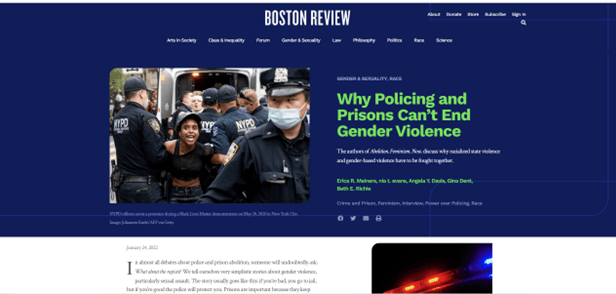
This article touches on the works of Angela Davis, Gina Dent, Erica Meiners, and Beth Richie and a conversation which they held togehter.
In their conversation, they talk about the work that they have achieved together working for the purposes of prison abolition when it comes to domestic violence. They discuss their feminist ideologies, as well as challenges those suffering domestic violence face when it comes to getting their issues addressed. The carceral system often does more harm than good when it comes to dealing with domestic violence, and these four seek to remedy this through prison abolition.
I encourage you to view the article by clicking the link above, as it provides valuable insight into both the works of the four women as well as a prison abolitionist stance on dealing with domestic violence.
-
This article is written from the perspectives of both Leigh Goodmark and Floyd Collins. Collins founded a program aimed at combating domestic violence called Awareness Into Domestic Violence in 2014 while serving a life sentence for murdering the mother of his child and works together with Goodmark in ways to effectively address the issue of domestic violence.
The article touches on the fact that for the past while, the thought process for dealing with perpetrators of domestic violence was to hold them accountable through the use of incarceration. The article, however, points out the reality that prisons themselves do nothing to prevent further acts of domestic violence, as individuals placed in prisons often are exposed to violence and trauma which only exacerbates existing issues within those who committed acts of domestic violence in the first place. Furthermore, the article states that there are little to no programs that effectively address the issues perpetrators have in the first place, and that if there are programs they are often not quality controlled.
The articles explores Collins’ journey throughout the carceral system, his turn around through attending college programs and “self-help” groups, leading to him founding the program Awareness Into Domestic Violence (AIDA) in 2014. The AIDA program seeks to challenge perpetrators “distorted beliefs”, as well as educating perpetrators on recognizing what causes them to act out in that way, by allowing group discussions with other domestic violence perpetrators.
I encourage you to view the article by clicking the link above and hopefully you will become more familiar with the AIDA program, other programs that are being offered within prisons, as well as the issue of the use of incarceration to address domestic violence and the negative effects that this has on individuals.

 Domestic Violence & Prison Abolition